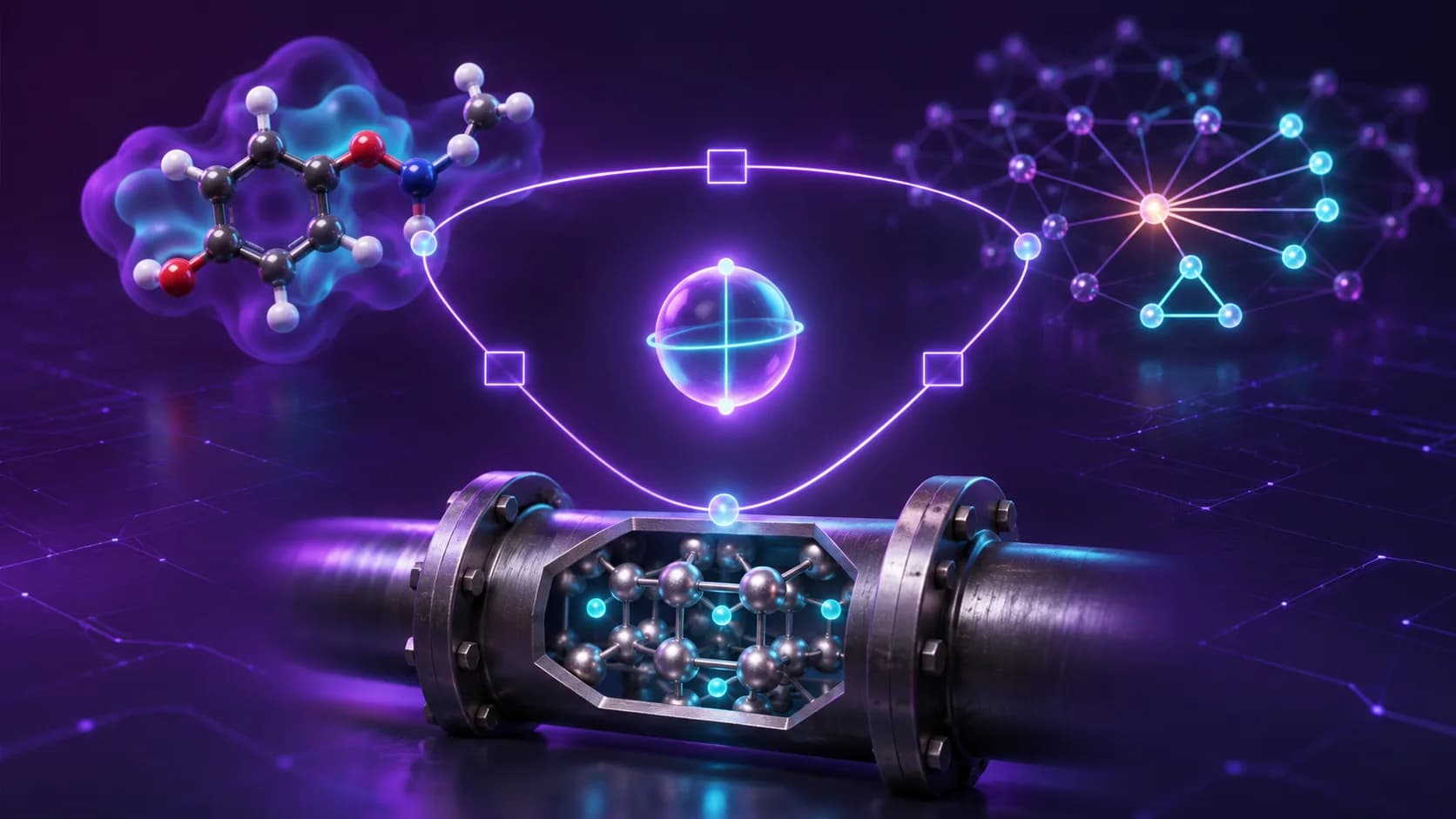
2026 Quantum Applications Hackathon
qBraid, the National Quantum Algorithm Center (NQAC) and the Polsky Center are running the 2026 Quantum Applications Hackathon as part of Quantum Developer Day. Quantum startups take on a real industry problem supplied by an industry end user and propose a working quantum or quantum+AI solution against it.
Submission deadline
- Due December 2, 11:59 PM CT
- Judging on December 3. Winners are notified Friday, December 4.
- $1,000 to the winning team
- The winner presents at Quantum Developer Day on December 7.
- Quantum startups, pre-seed to Series C
- Startup-led teams, with academic, student and industry partners welcome. No cap on teams.
- qBraid resources
- Opt in to qBraid licenses and credits for QPUs, GPUs and CPUs, or bring your own tools.
Three industry challenges
Each team picks one. Every problem comes from an industry end user, and the references and datasets are a starting point, not a requirement.

Improving drug discovery
Objective
Develop an idea to demonstrate potential quantum advantage for predicting small-molecule properties that inform hit identification or lead selection. Quantum sensing approaches to molecular property measurement are also eligible.
Many drug candidates fail in development because of poor absorption, distribution, metabolism, excretion or toxicity (ADMET) profiles rather than lack of efficacy. Predicting these properties computationally during hit identification and lead selection lets discovery teams drop weak compounds before committing to costly synthesis and assays. Machine learning models now support these decisions routinely, but predictions of molecular properties are still highly variable.
Quantum methods can contribute in various ways. For example, quantum and quantum-AI hybrid machine learning methods may extract more signal from small datasets, and quantum simulation of electronic structure can generate physically grounded molecular descriptors that classical methods approximate poorly.
References
- Blunt, N.S. et al. (2022). Perspective on the current state-of-the-art of quantum computing for drug discovery applications. Journal of Chemical Theory and Computation.
- Huang, K. et al. (2021). Therapeutics Data Commons: Machine learning datasets and tasks for drug discovery and development. NeurIPS 2021 Datasets and Benchmarks Track.
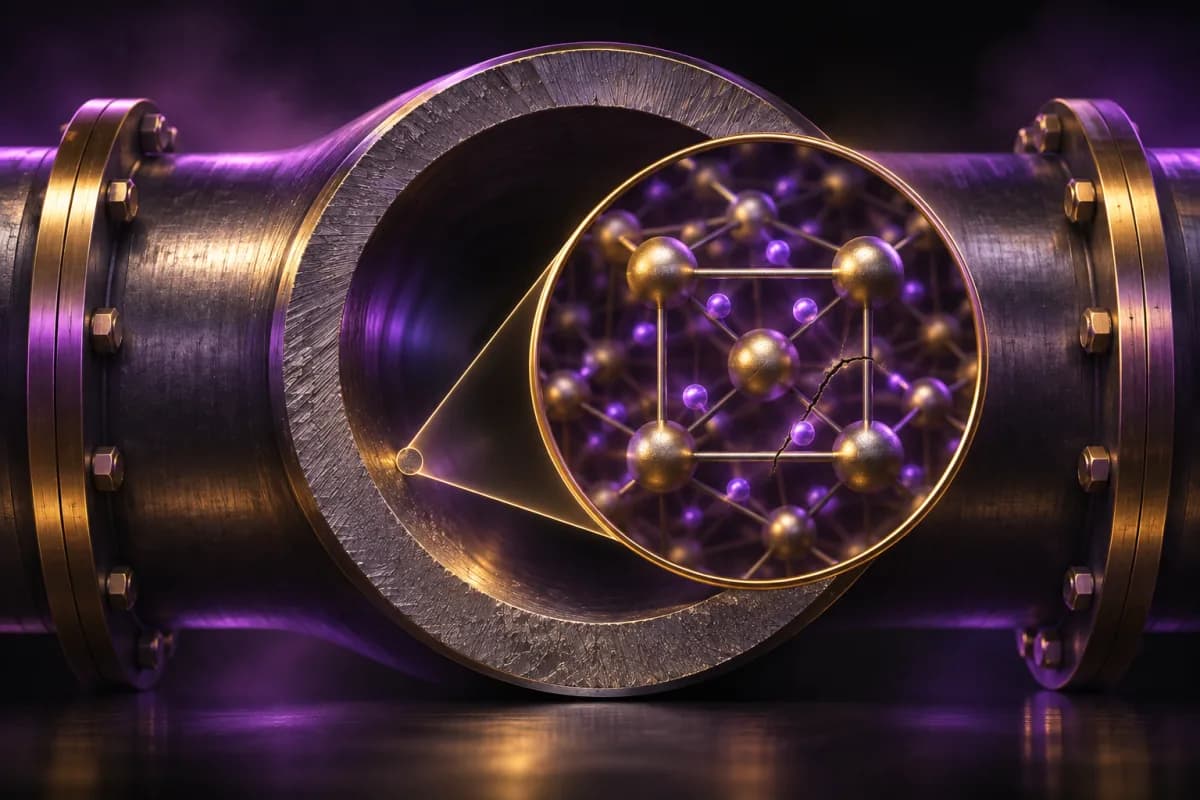
Developing more resilient pipes
Objective
Develop an idea to demonstrate potential quantum advantage for predicting toughness degradation or corrosion likelihood in gas pipeline steels. Entries may address any link in the chain, such as:
- quantum simulation of hydrogen trapping or corrosion reactions;
- quantum or quantum-AI models linking composition and operating conditions to failure risk; or
- quantum sensing for inspection.
Teams state the classical method they improve on and how their approach fits into a pipeline integrity-management workflow.
The U.S. gas network relies on steel pipe, much of it decades old. Its integrity depends on properties such as fracture toughness, which governs resistance to crack growth, and corrosion susceptibility, which thins pipe walls and creates the defects where cracks begin. Steel chemistry and microstructure govern both properties, and hydrogen degrades both.
Hydrogen enters the steel from corrosion reactions and cathodic protection at the pipe surface, and increasingly from the gas stream itself as operators evaluate hydrogen blending. Its detrimental effects on the steels used in existing pipe networks are a central safety uncertainty for repurposing that infrastructure.
Current integrity models are largely empirical and extrapolate poorly to conditions with little field history, such as hydrogen service. The underlying hydrogen–iron and surface electrochemistry interactions are electronic-structure problems where quantum simulation has a credible long-term role. Quantum sensing offers a route to detecting stress, defects and corrosion damage in place.
References
- Ohaeri, E., Eduok, U., & Szpunar, J. (2018). Hydrogen related degradation in pipeline steel: A review. International Journal of Hydrogen Energy, 43(31), 14584.
- Coelho, L.B. et al. (2022). Reviewing machine learning of corrosion prediction in a data-oriented perspective. npj Materials Degradation, 6, 8.
- Bauer, B. et al. (2020). Quantum algorithms for quantum chemistry and quantum materials science. Chemical Reviews, 120(22), 12685–12717.

Detecting illicit money movement in high-value payments
Objective
Develop an idea to demonstrate potential quantum advantage for detecting fraudulent or illicit money movement in high-value payment flows where such events are extremely rare. Hybrid approaches, in which a quantum component augments a classical transaction-monitoring pipeline, are welcome.
Financial services firms move money for customers, business owners and institutional investors through private and business banking, treasury management and cash management services. At least two threats concentrate in these payment flows:
- Payment fraud. Through account takeover and business email compromise, a criminal impersonates a client, advisor or counterparty in order to redirect a wire.
- Money laundering. Illicit funds pass through a chain of accounts to conceal their origin, often crossing banks and national borders.
Both are rare relative to legitimate activity and high in value per event. Both are also more visible in the pattern of relationships between accounts than in any single transaction, through patterns such as fan-out, fan-in, cycles and rapid layering. Detection is therefore a graph problem with extreme class imbalance. Incomplete labels compound the difficulty, because many illicit transactions in real data are never detected.
Quantum methods can contribute at various points, such as:
- quantum classifiers for rare-event detection;
- quantum generative models that augment scarce positive examples; and
- quantum optimization for locating suspicious subgraph patterns in large transaction networks.
References
- Altman, E. et al. (2023). Realistic synthetic financial transactions for anti-money laundering models. NeurIPS 2023 Datasets and Benchmarks Track.
- Grossi, M. et al. (2022). Mixed quantum–classical method for fraud detection with quantum feature selection. IEEE Transactions on Quantum Engineering.
- Herman, D. et al. (2023). Quantum computing for finance. Nature Reviews Physics, 5, 450–465.
Timeline
Winners are notified on Friday, December 4. That is a fast turnaround, because Quantum Developer Day is the following Monday.
- 1Until Dec 2
Register and build
Join the Discord, register your team and pick one challenge.
- 2Wed, Dec 2
Submissions due
Your slides, plus a private GitHub repo with your prototype.
- 3Thu, Dec 3
Judging
A panel of industry and technical judges selects the winner.
- 4Fri, Dec 4
Winners notified
A fast turnaround, because Quantum Developer Day is the following Monday.
- 5Mon, Dec 7
Winner presents
The winning team presents its approach at Quantum Developer Day.
How to enter
Register on Discord, pick a challenge, then submit slides and a working prototype.
Register your team
- 1
Join the qBraid Discord
Open the #hackathon-registration channel.
- 2
Every team member registers
Each member fills out the private registration form linked in the channel.
- 3
Post your team
One person per team opens a post with the team name, members and GitHub usernames.
- 4
Pick one challenge
Each team selects one of the three challenges and submits a single proposal for it.
What to submit
A 5–8 slide presentation that:
- Proposes an application approach that addresses the selected problem.
- Justifies why a quantum, quantum-AI hybrid or quantum sensing approach offers potential advantage over classical methods.
- Sets out a research roadmap describing how the approach will be developed, validated and scaled.
An application prototype in a private GitHub repository, which is then shared with the judges.
Benchmarking results that demonstrate application performance are welcome but not required.
Submissions are due December 2, 11:59 PM CT. Submission instructions are posted in the Discord.
Judging and prizes
A panel of industry and technical judges reviews every entry against three questions.
Quantum advantage
Did the team propose a plausible approach to demonstrate how quantum would have advantage over classical methods for addressing the problem?
Real-world impact
Did the team articulate how this approach would have a meaningful impact on the real-world problem?
Realistic roadmap
Did the team articulate a realistic roadmap for assessing its approach?
$1,000
Awarded to the winning team.
Quantum Developer Day
The winning team presents its approach at Quantum Developer Day on December 7.
2027 showcase
Winners and runners-up can showcase their approaches through the NQAC's member network and other events in 2027.
Eligibility and rules
The competition invites quantum startups to show how quantum applications, quantum-AI hybrid applications and quantum sensing can address real-world industry problems.
Who can enter
Quantum startups from pre-seed through Series C. The submitting startup must be a legal entity, and it serves as the lead entrant.
Team partners
Teams may include partners from academia, students, other quantum companies or other organizations that strengthen the proposal.
No cap on teams
The competition is open to all eligible startups. Duality Accelerator startups receive priority consideration.
Your IP stays yours
Teams retain all IP rights to their challenge solutions, but must allow the judges to view their solutions solely for grading.
Use any tools
Every team can opt in to qBraid licenses and credits for QPUs, GPUs, CPUs and other resources. Teams can use whatever tools they prefer.
References and datasets
The references and datasets for each challenge are illustrative: background on the problem and a starting point for analysis. Teams are free to use other datasets, literature and resources.
Common questions
Anything else? Ask in the qBraid Discord, where teams register.
Can students or researchers take part?
Yes, as partners on a startup-led team. The startup serves as the lead entrant.
Do we have to use qBraid or the listed datasets?
No. Use whatever tools and data fit your approach. qBraid licenses and compute credits are there for every team that opts in.
Can we enter more than one challenge?
No. Each team picks one challenge and submits a single proposal for it.
Are benchmarks required?
No. Benchmarking results that show application performance are welcome but not required.
Partners
Organized by qBraid, NQAC and the Polsky Center, with challenge problems from three industry end users.
Organized by
qBraid
Host of Quantum Developer Day
NQAC
National Quantum Algorithm Center
Polsky Center
University of Chicago
Challenge partners
Excelsior Labs
Challenge 1: Drug discovery
GTI
Challenge 2: Resilient pipes
Northern Trust
Challenge 3: Illicit payments